Launch offer — valid today only

📄 Digital book in PDF · read it on your phone or print it

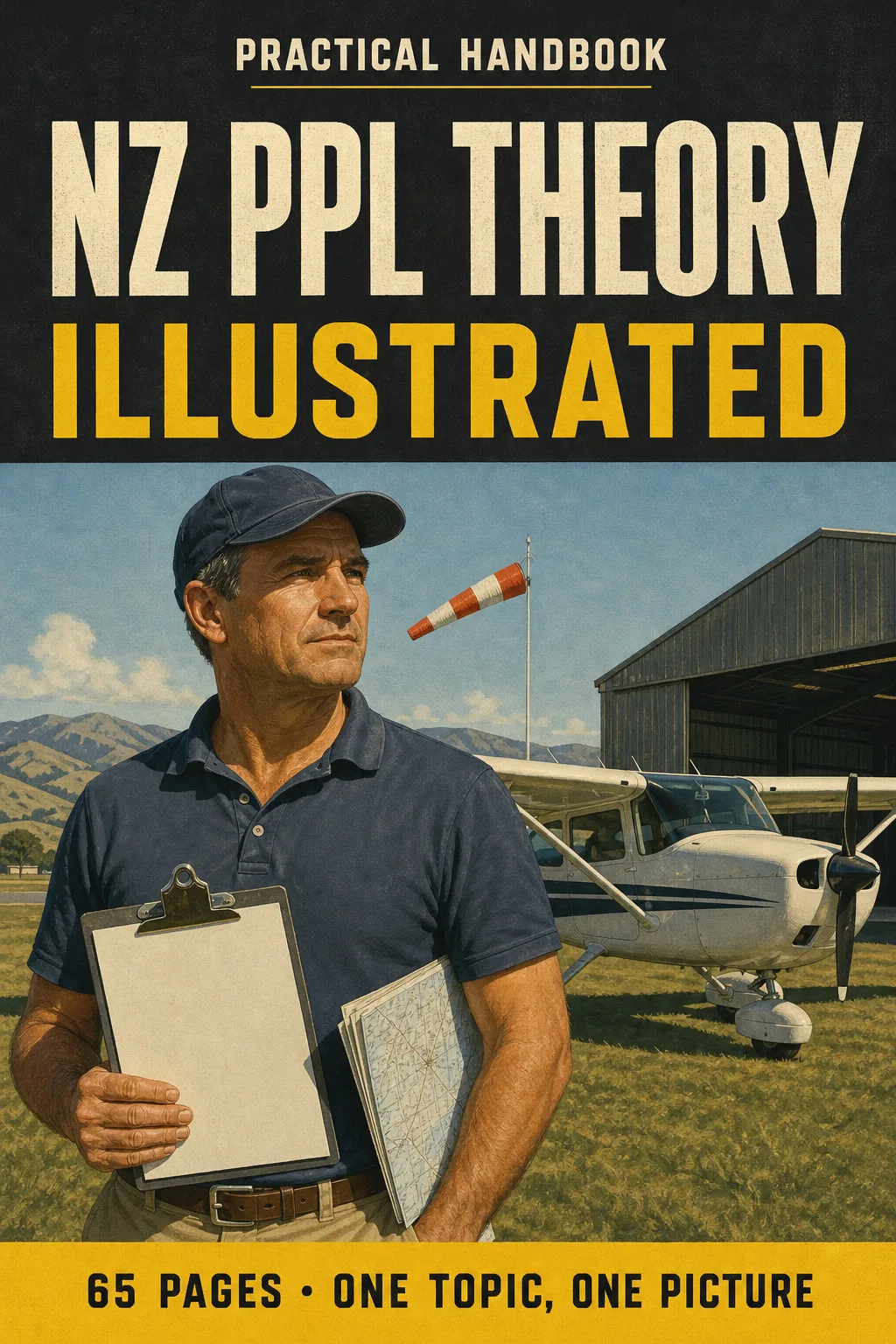
The NZ PPL Theory Exams in Drawings One Topic on Every Page

Airspace on the chart, circuit joining, radio calls, METARs and TAFs, the triangle of velocities, fuel planning, I'M SAFE and the aircraft systems. Each topic has its own page: first the drawing, then what you need to remember. 65 illustrated pages.

START STUDYING THIS WAY

🔒 Secure checkout · PDF by email · 30-day guarantee

Every topic, its own pageEach rule and each calculation drawn, with the explanation right beside it
65 illustrated pages8 parts, from the six exams on one page to your exam day checklist
Up-to-date sourcesCivil Aviation Rules Parts 61, 71 and 91, the AIP New Zealand and the PPL theory syllabus
PDF by emailFormat

Look Inside the Book

Every page has one big drawing and a box with the numbers, rules and steps you need to know:

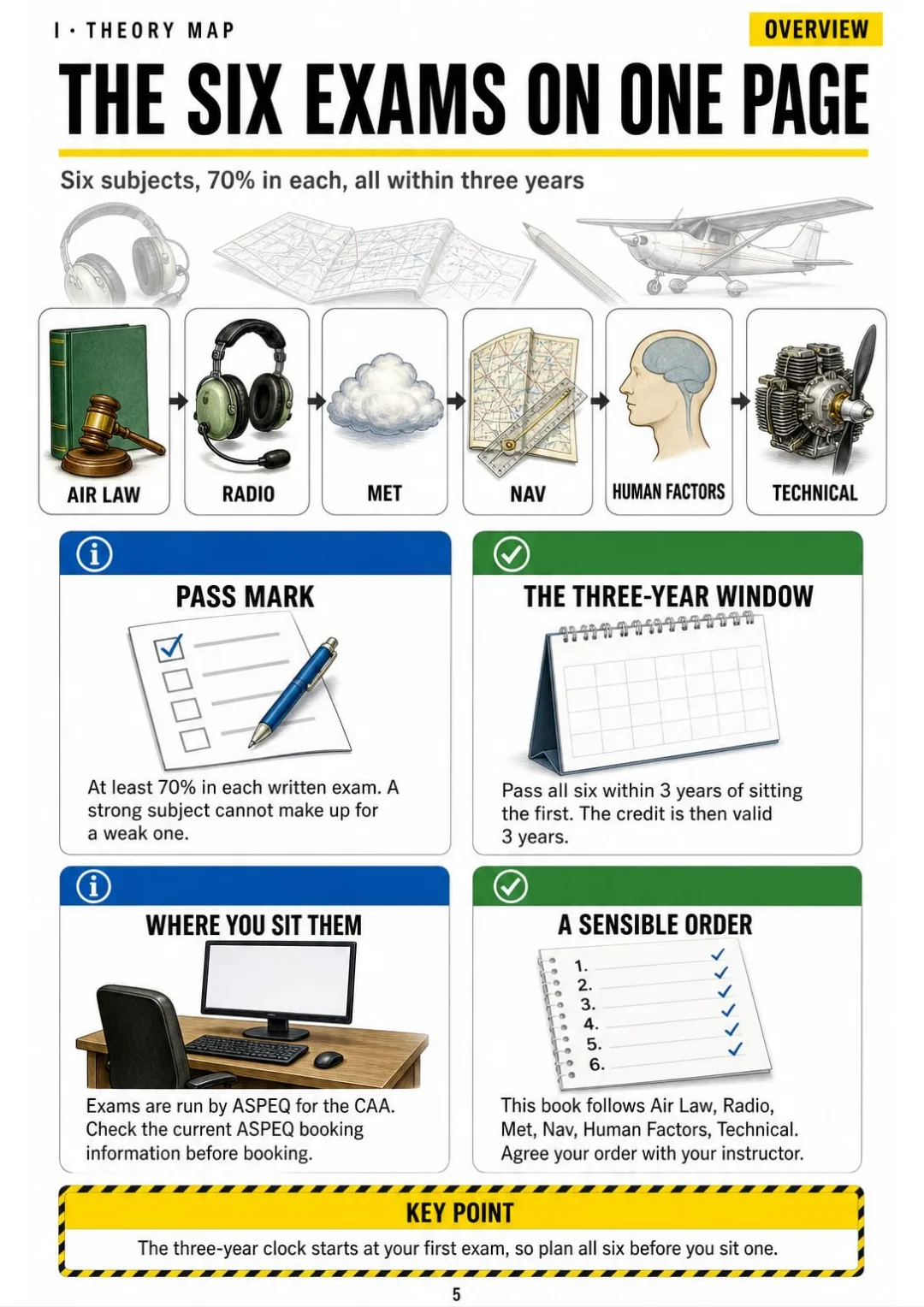
Six subjects · 70% in each · all passed within 3 years of the first exam
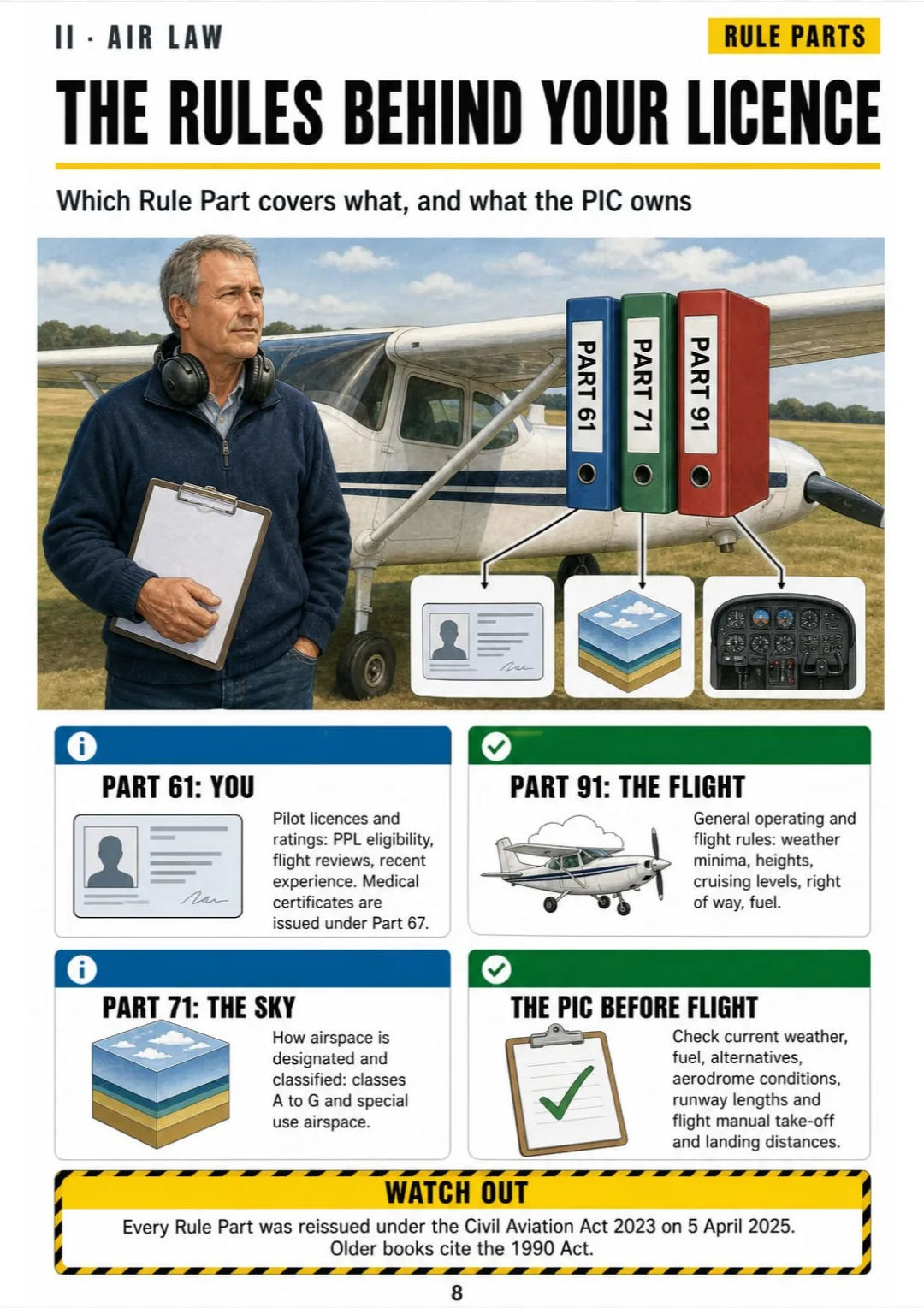
Part 61 covers you, Part 91 the flight, Part 71 the airspace
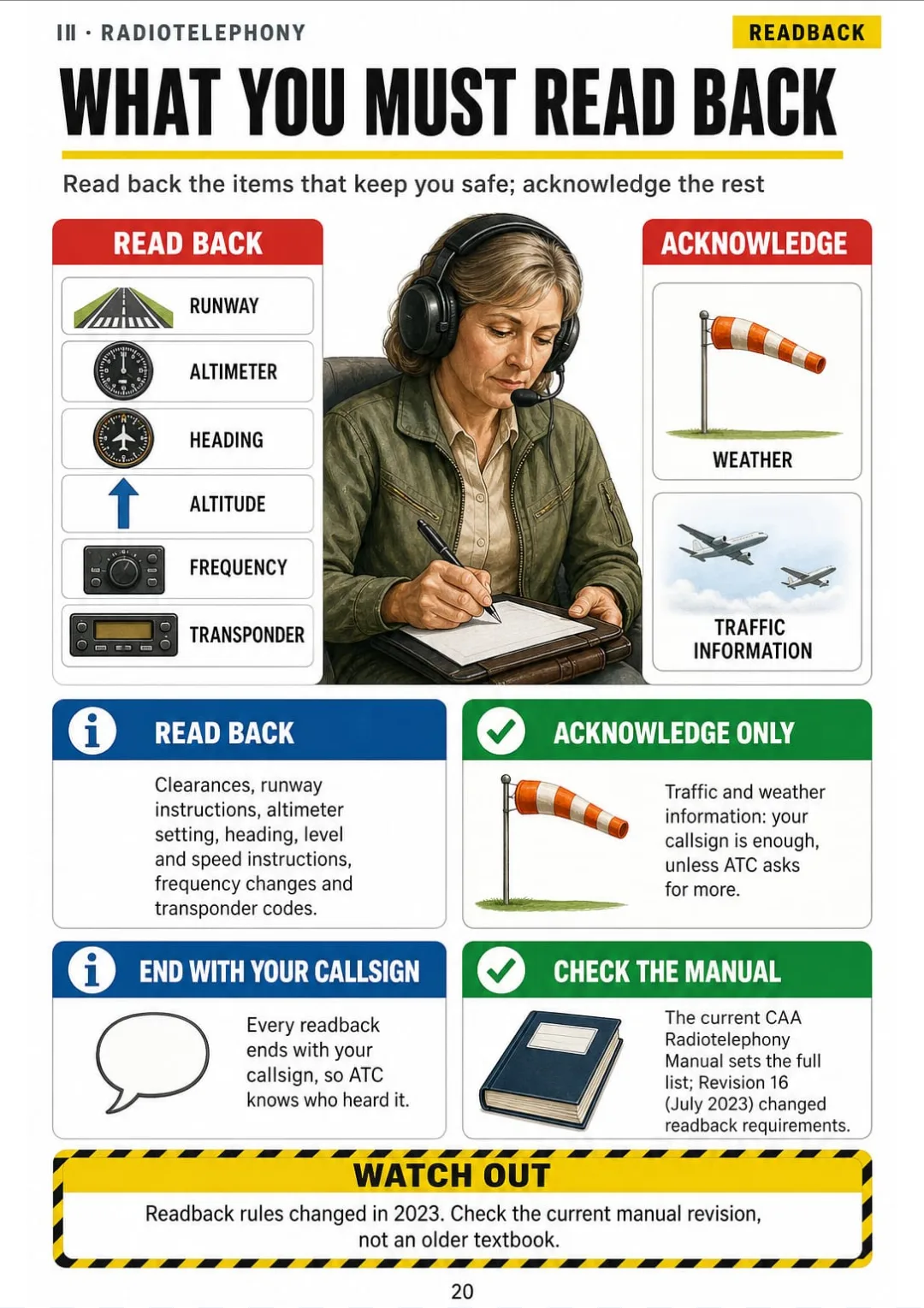
Readback versus acknowledge, sorted by item
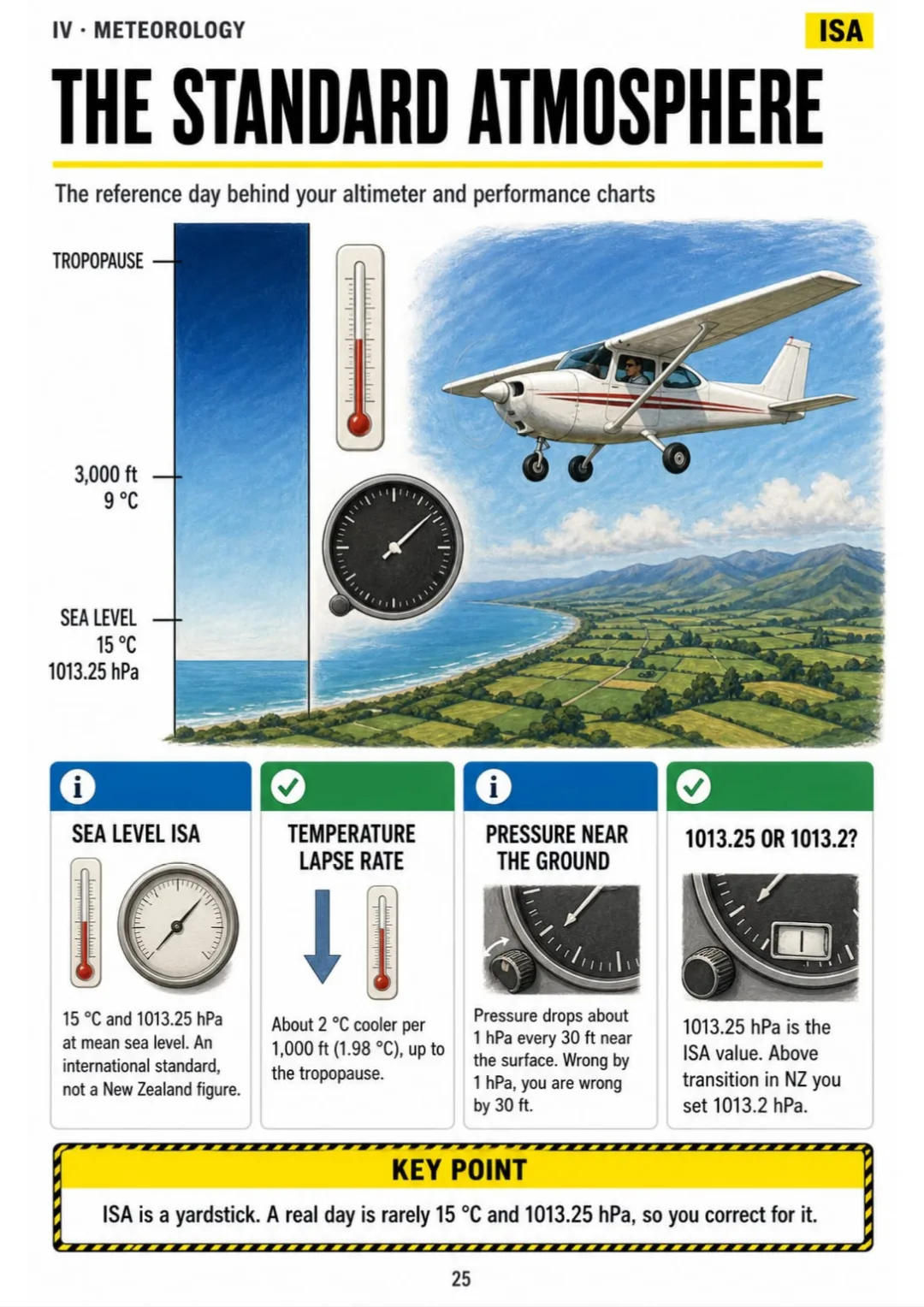
ISA: 15 °C and 1013.25 hPa at sea level, about 2 °C cooler per 1,000 ft, 1 hPa ≈ 30 ft.
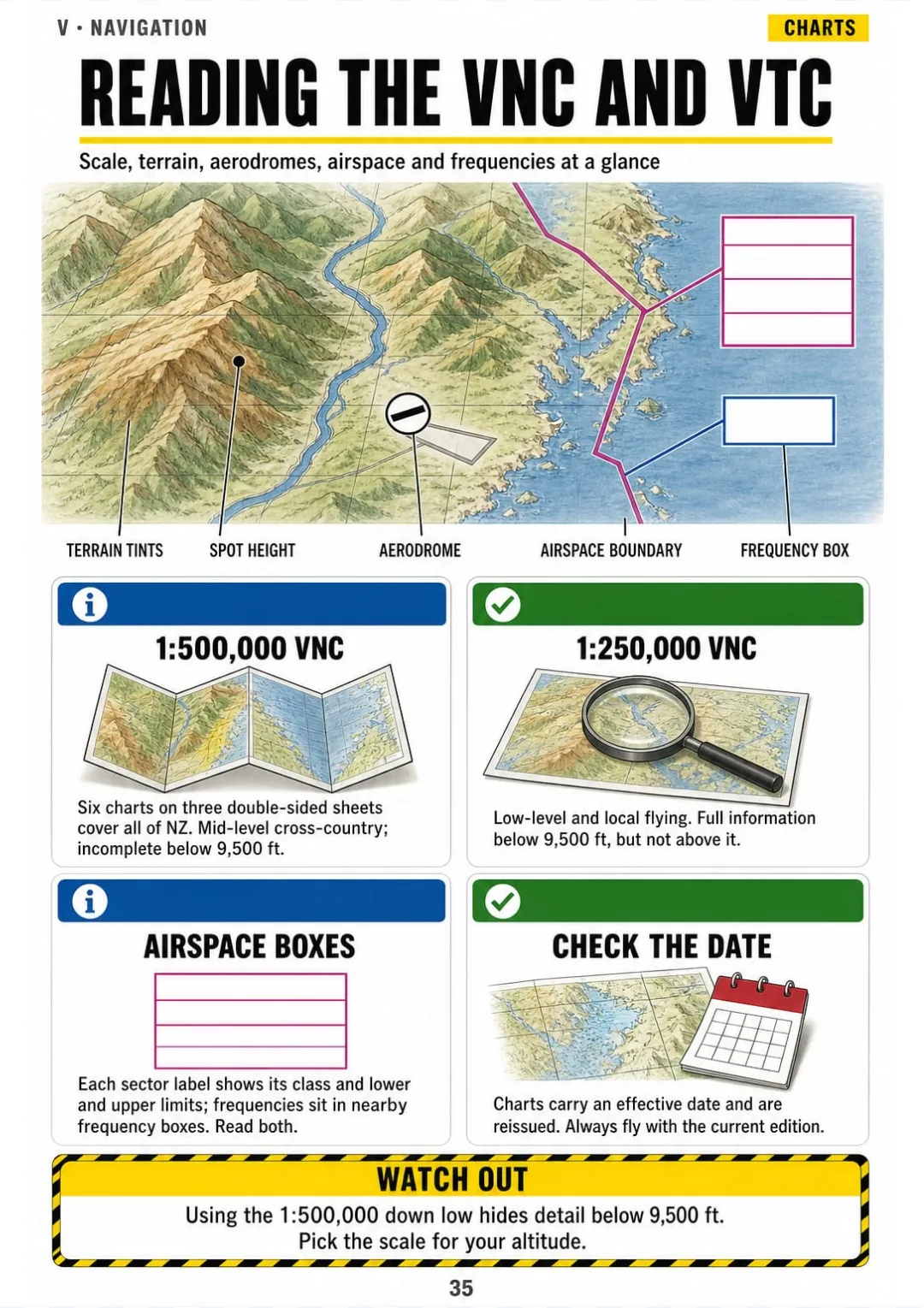
VNC 1:500,000 for mid-level cross-country, 1:250,000 for low-level detail below 9,500 ft.
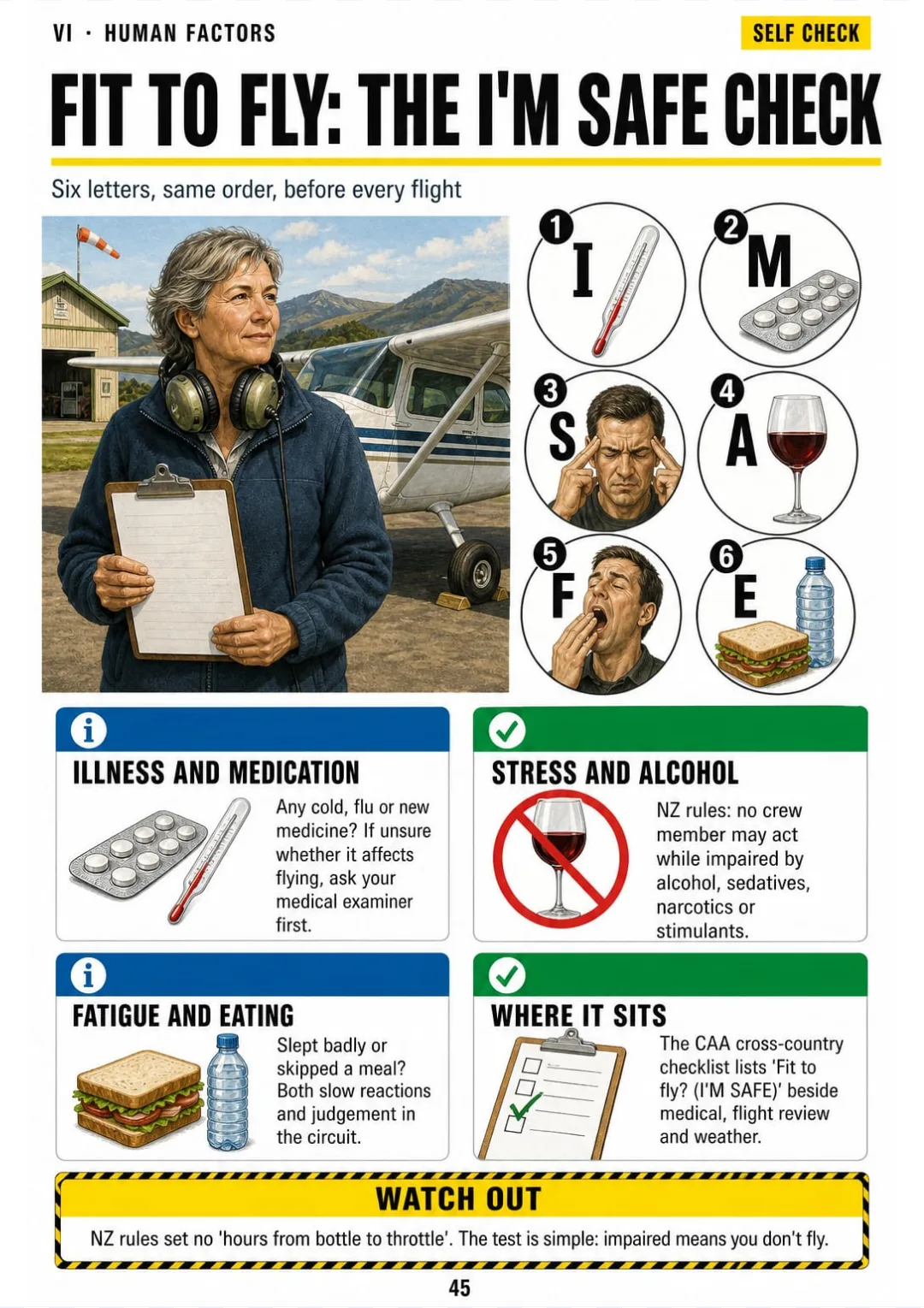
I'M SAFE: Illness, Medication, Stress, Alcohol, Fatigue, Eating, checked before every flight.
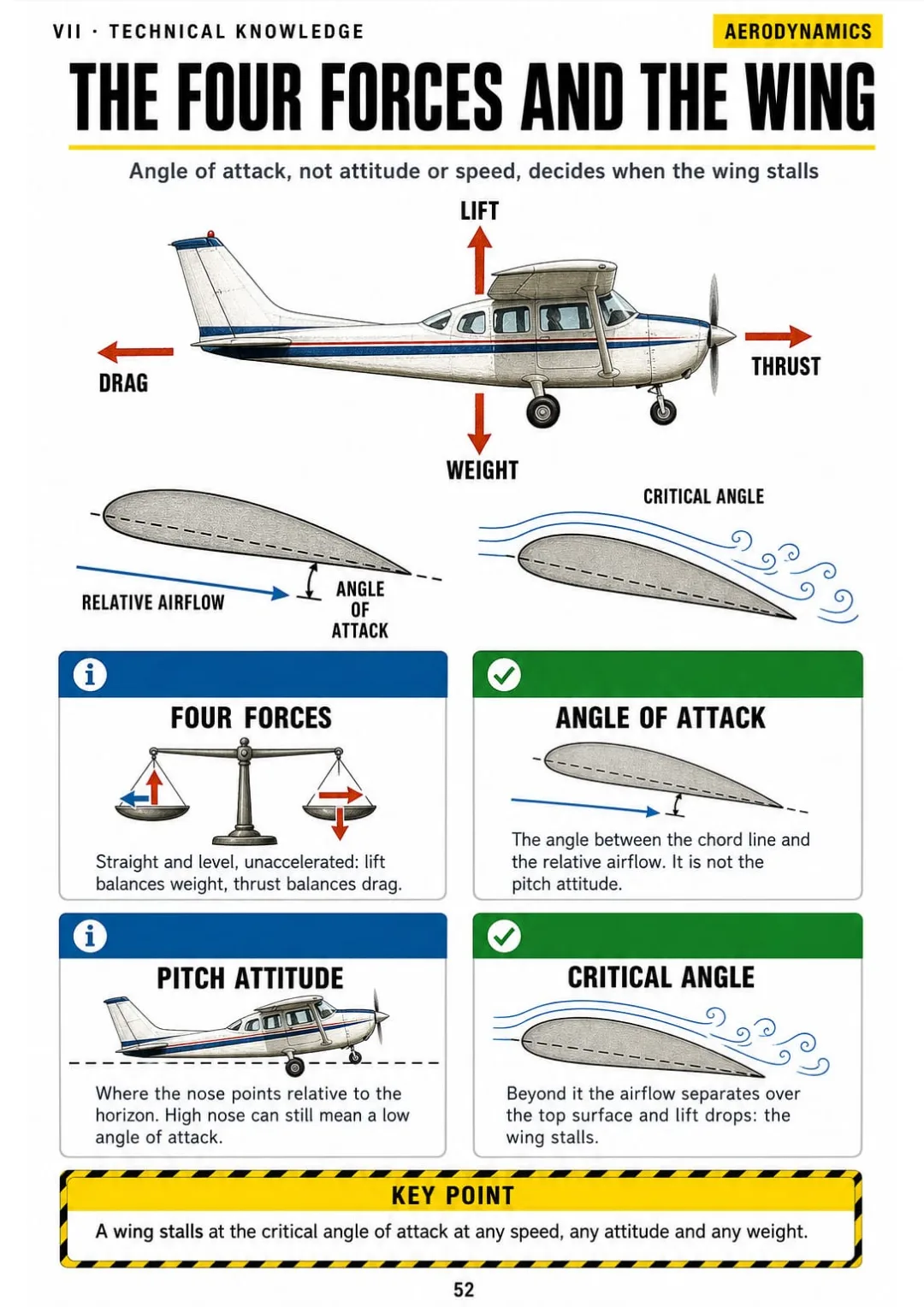
Lift, weight, thrust, drag, and why the stall is about angle of attack, not speed
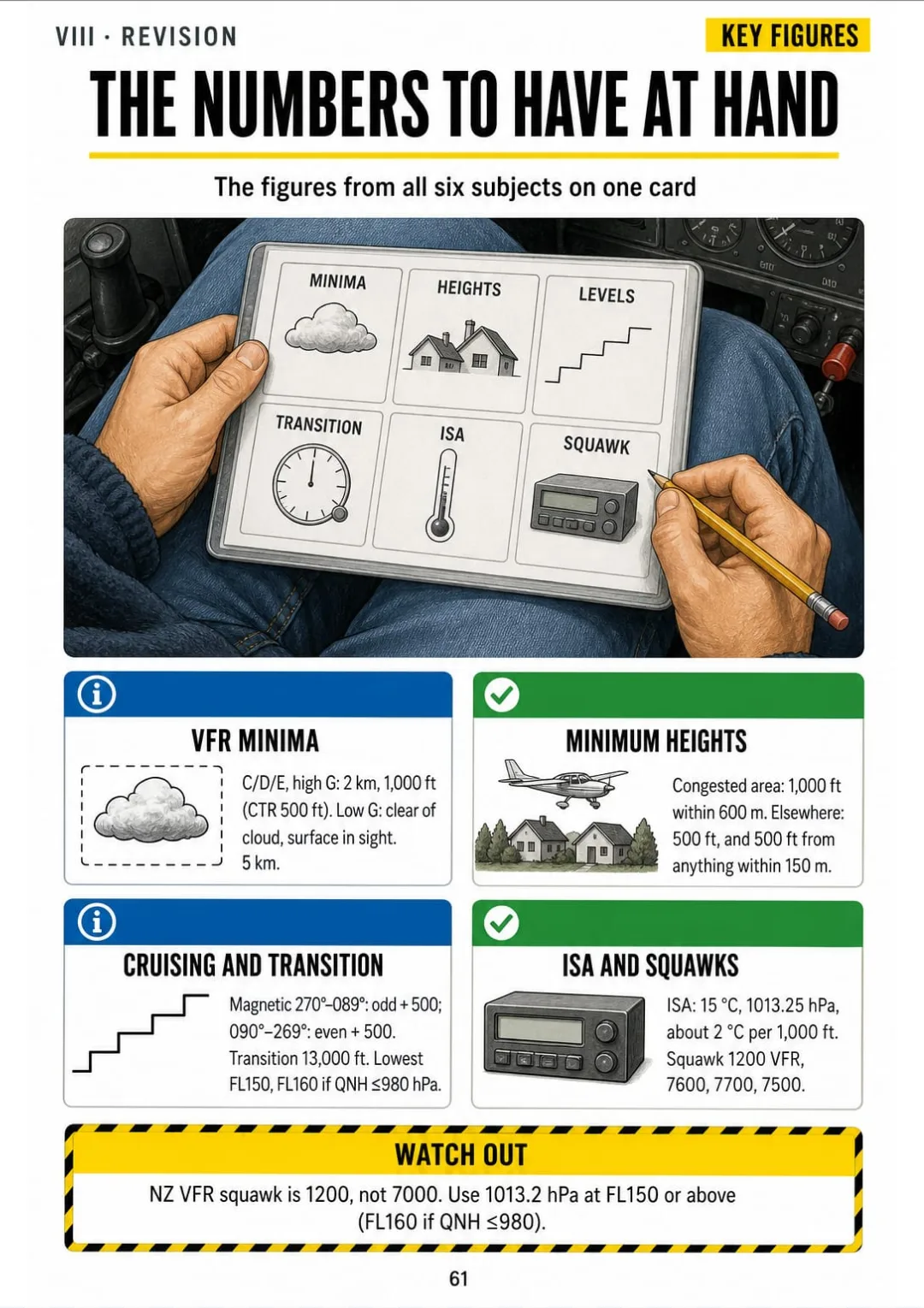
VFR minima, heights, cruising levels, 13,000 ft transition, ISA and squawk codes on one card

Swipe to see more →

These are real pages from the book. The table of contents is the full one: 8 parts and 61 topics.

The Problem Isn't You. It's How It Was Explained.

You're at the holding point with your finger on the transmit button. Heading, altitude, frequency: you know them all, and still halfway through the call the numbers come out in the wrong shape.

It isn't a gap in your study. The manual gives you the phonetic alphabet as a list, then explains in paragraphs how each kind of number is spoken. Read at the kitchen table, it doesn't come back in the cockpit.

Readback versus acknowledge, sorted by item

In this book it's one page. The ten digits are drawn with their spoken forms, and next to them a heading, an altitude and a frequency, each one split up the way you say it on air.

The rest of the book works the same way: airspace on the chart, circuit joining seen from above, the METAR group by group, the triangle of velocities, I'M SAFE. Each one on its own page.

Next time you press to transmit, you've already seen that call laid out, and it comes out in the right order without going back to the manual.

COMPARE FOR YOURSELF

The Same Topic, Two Ways to Study It

THIS
  • The manual: line after line
  • Parts 61, 91 and 71 explained only in words
  • You walk into the Air Law exam unsure
The Civil Aviation Rules are made under the Civil Aviation Act and are arranged in Parts, each of which addresses a distinct area of aviation activity. Part 61 prescribes the requirements for the issue of pilot licences and ratings, including the conditions relating to privileges, recency and flight reviews. Part 91 sets out the general operating and flight rules applicable to all aircraft, whereas Part 71 provides for the designation and classification of airspace, and must be read in conjunction with the relevant AIP New Zealand material and associated advisory circulars.
FOR THIS
  • The rules behind your licence in one drawing
  • Each Part and what it covers in a box
  • You see it and you get it
Part 61 covers you, Part 91 the flight, Part 71 the airspace
CONTENTS

Take a Look at the 8 Parts and 61 Topics

Your PPL theory map, Air Law, Flight Radiotelephony, Meteorology, Navigation and Flight Planning, Human Factors, Aircraft Technical Knowledge, and revision and exam day: 65 pages, all illustrated

IYour PPL theory map · pp. 5-7
  1. The six exams on one page
  2. How to read this book
  3. Units you will actually use
IIAir Law · pp. 8-17
  1. The rules behind your licence
  2. Licence, medical and flight review
  3. NZ airspace classes at a glance
  4. Special use airspace on the chart
  5. VFR weather minima
  6. Minimum heights
  7. VFR cruising levels
  8. Right of way
  9. Altimeter settings and transition
  10. Documents and pre-flight duties
IIIFlight Radiotelephony · pp. 18-24
  1. The phonetic alphabet and numbers
  2. The shape of every call
  3. What you must read back
  4. Calls at an unattended aerodrome
  5. Entering controlled airspace
  6. MAYDAY and PAN PAN
  7. Radio failure
IVMeteorology · pp. 25-34
  1. The standard atmosphere
  2. High to low, look out below
  3. Wind, pressure and the isobars
  4. Stability and cloud types
  5. Fronts over New Zealand
  6. Mountain waves and föhn
  7. Fog, icing and thunderstorms
  8. Decoding a METAR group by group
  9. Reading a TAF
  10. NZ area forecasts and warnings
VNavigation and Flight Planning · pp. 35-44
  1. Reading the VNC and VTC
  2. True, magnetic and compass
  3. The triangle of velocities
  4. Solving the wind triangle on the flight computer
  5. Time, speed and distance
  6. The 1 in 60 rule
  7. Fuel planning in litres
  8. Building the navigation log
  9. Lost procedure
  10. Diversion in the air
VIHuman Factors · pp. 45-51
  1. Fit to fly: the I'M SAFE check
  2. Hypoxia and oxygen
  3. Spatial disorientation
  4. Seeing other traffic
  5. Carbon monoxide and other hazards
  6. Decision making and threat management
  7. Fatigue, stress and workload
VIIAircraft Technical Knowledge · pp. 52-60
  1. The four forces and the wing
  2. Stalls, flaps and load factor
  3. The four-stroke engine
  4. Carburettor icing and mixture
  5. Fuel, oil and electrical systems
  6. Pitot-static instruments
  7. Gyro instruments and the compass
  8. Weight and balance
  9. Performance and density altitude
VIIIRevision and exam day · pp. 61-65
  1. The numbers to have at hand
  2. Six subjects, six one-minute reviews
  3. The most common mistakes
  4. Your revision plan around flying
  5. Exam day checklist

One Page, One Topic, All Clear

Think of it this way:

It's a weeknight, the Navigation exam is coming up, and the question reads: track 180, wind 270 at 20 knots. You need to know which way to point the nose.

You open the page on the triangle of velocities and there it is, drawn: the track line, the wind arrow and the heading closing the triangle, built in the same steps every time.

VNC 1:500,000 for mid-level cross-country, 1:250,000 for low-level detail below 9,500 ft.

Then the same with VFR weather minima, the METAR group by group, the 1 in 60 rule, carburettor icing and weight and balance: each one on its own page.

NZ PPL Theory Illustrated is 65 illustrated pages in 8 parts, one topic per page, and it finishes with the numbers to have at hand, six one-minute reviews and an exam day checklist.

What you see drawn, you don't have to memorize.

What's Inside NZ PPL Theory Illustrated:

Ipp. 5-7

Your PPL theory map

The six exams on one page, how to read the book and the units you'll actually use: metres, feet, knots, hectopascals and litres.

IIpp. 8-17

Air Law

The rules behind your licence, medical and flight review, airspace classes, special use airspace, VFR minima, minimum heights, cruising levels, right of way, altimeter settings and pre-flight duties.

IIIpp. 18-24

Flight Radiotelephony

The phonetic alphabet and numbers, the shape of every call, readbacks, calls at an unattended aerodrome, entering controlled airspace, MAYDAY, PAN PAN and radio failure.

IVpp. 25-34

Meteorology

The standard atmosphere, pressure and wind, stability and cloud, fronts over New Zealand, mountain waves and föhn, fog, icing, thunderstorms, METARs, TAFs and area forecasts.

Vpp. 35-44

Navigation and Flight Planning

The VNC and VTC, true, magnetic and compass, the wind triangle on paper and on the flight computer, time-speed-distance, the 1 in 60 rule, fuel in litres, the nav log, lost procedure and diversions.

VIpp. 45-51

Human Factors

I'M SAFE, hypoxia and oxygen, spatial disorientation, seeing other traffic, carbon monoxide, decision making and threat management, fatigue, stress and workload.

VIIpp. 52-60

Aircraft Technical Knowledge

The four forces and the wing, stalls, flaps and load factor, the four-stroke engine, carb icing and mixture, fuel, oil and electrics, pitot-static and gyro instruments, weight and balance, and density altitude.

VIIIpp. 61-65

Revision and exam day

The numbers to have at hand, six one-minute reviews, the most common mistakes, a revision plan around your flying and an exam day checklist.

At the end of the book: The numbers on one card, six one-minute reviews, the most common mistakes and an exam day checklist.
Plus: 2 Free Books

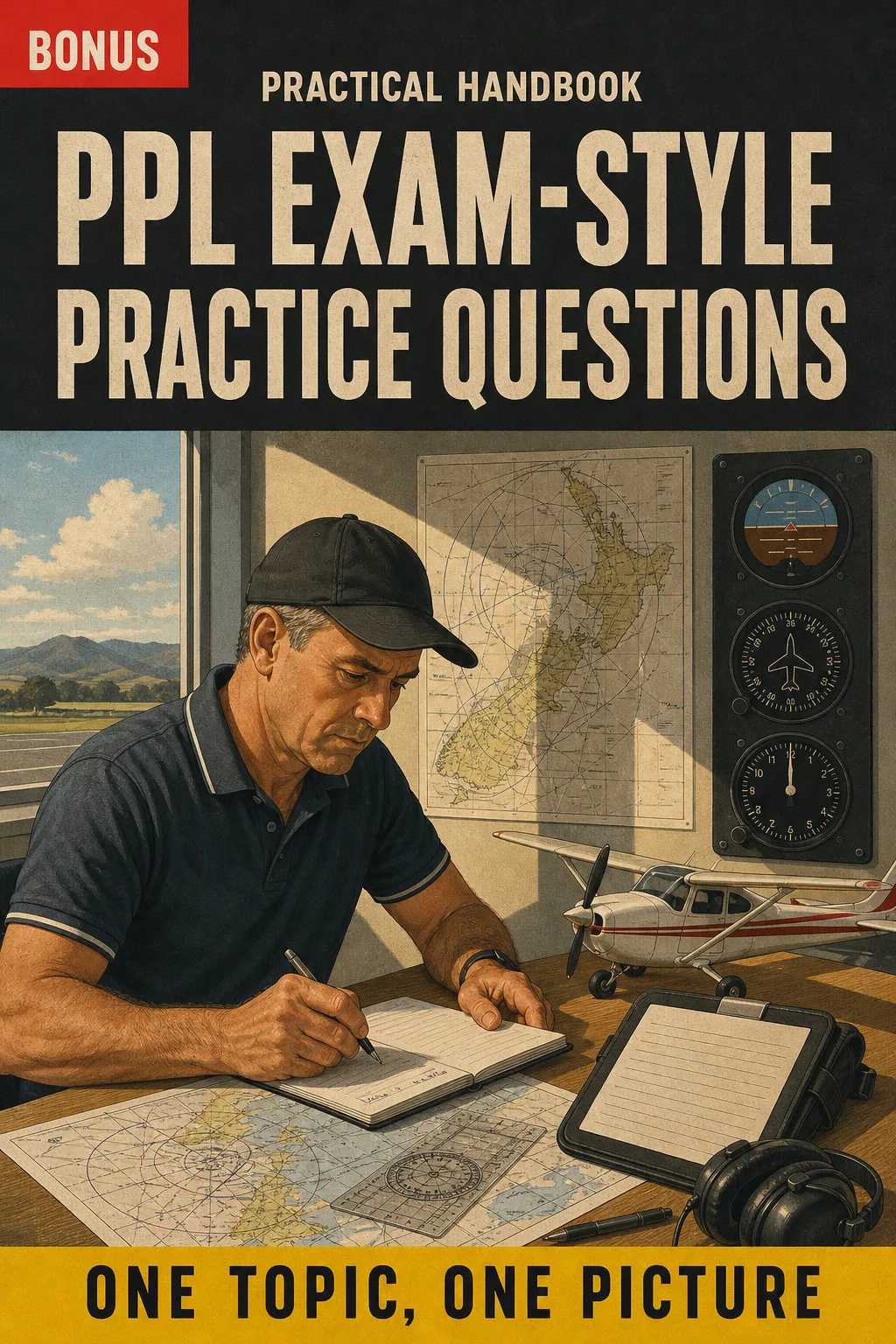
PPL Exam-Style Practice Questions

BONUS 1: «PPL Exam-Style Practice Questions»

Value on its own: US$ 17.90

Practise every subject with exam-style questions and worked answers, so you find your gaps before the real exam does.

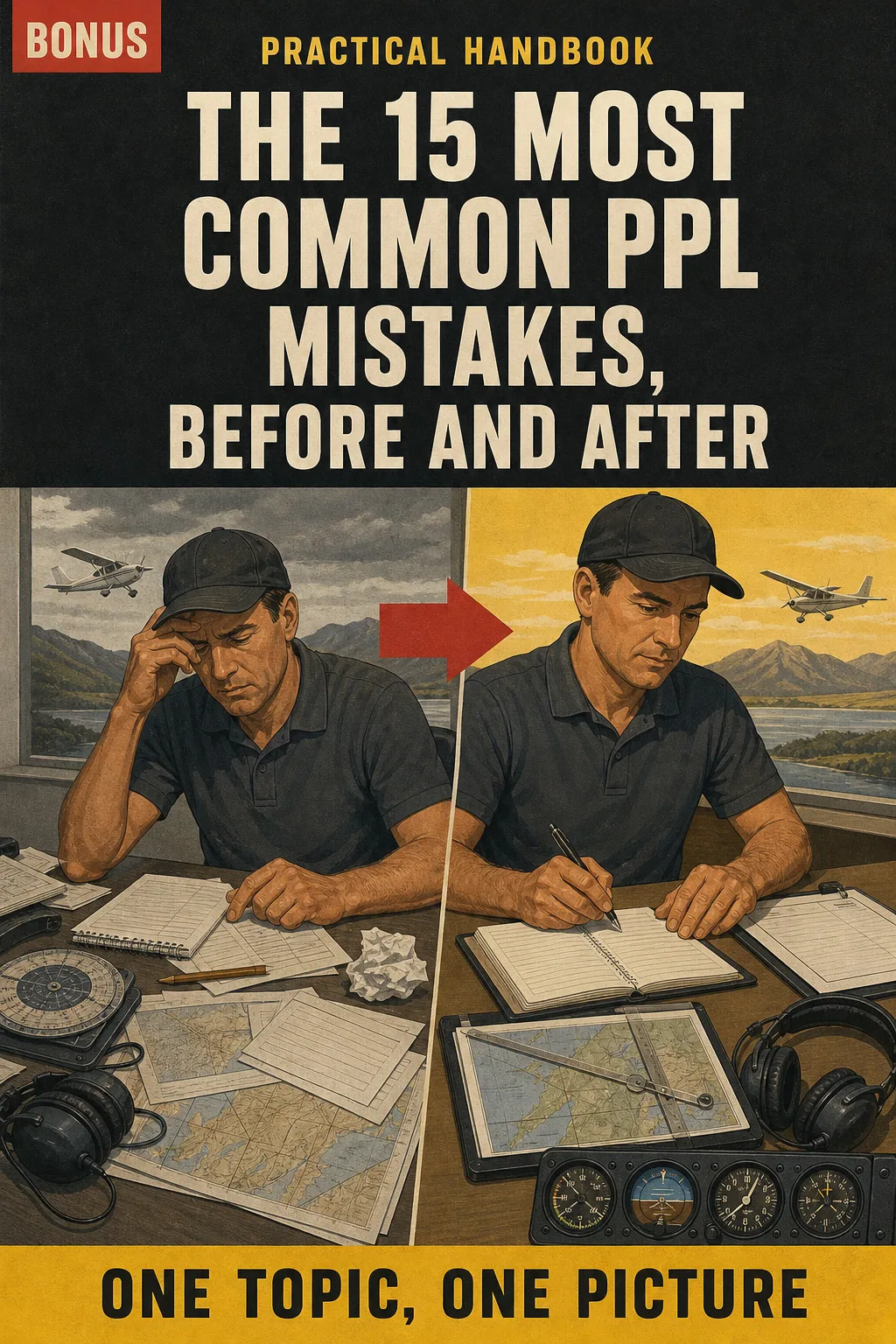
The 15 Most Common PPL Mistakes, Before and After

BONUS 2: «The 15 Most Common PPL Mistakes, Before and After»

Value on its own: US$ 14.90

See the errors student pilots make most often, side by side with the right way, so you stop repeating them on the day.

NZ PPL Theory Illustrated with 2 Free Books

  • NZ PPL Theory Illustrated: 65 illustrated pagesUS$ 63
  • BONUS 1: PPL Exam-Style Practice QuestionsUS$ 17.90
  • BONUS 2: The 15 Most Common PPL Mistakes, Before and AfterUS$ 14.90
  • High-resolution PDF to printIncluded
Total value US$ 95.80
YOUR PRICE:
US$ 27
You save US$ 68.80
YES, I WANT NZ PPL THEORY ILLUSTRATED FOR US$ 27

📄 This is a digital PDF book sent to your email: nothing is printed or shipped.

Secure purchaseEncrypted payment30-day guarantee

PDF by email: We email you NZ PPL Theory Illustrated as a PDF, together with the two free books. It's a single payment: no installments, no extra charges.

Who This Book Is For

You're starting the PPL theory

You're starting the PPL theory

You fly at the weekend and study at night. Every subject comes in the same order, one topic per page, so short sessions actually add up.

Your next exam is close

Your next exam is close

Navigation, Met or Air Law coming up? The numbers card and the one-minute reviews let you go over a whole subject in one sitting.

You're coming back to flying

You're coming back to flying

Years away from the cockpit? Refresh the rules, the radio and the aircraft systems page by page before you sit down with your instructor.

Everything You Get Today

US$ 95.80US$ 27
YES, I WANT NZ PPL THEORY ILLUSTRATED FOR US$ 27

📄 This is a digital PDF book sent to your email: nothing is printed or shipped.

30DAYS
GUARANTEE

30-Day Guarantee

Try NZ PPL Theory Illustrated for 30 days, bonus books included.

We refund everything if the file won't open, if the book isn't what you see here, if you were charged twice or if the email doesn't arrive. Just email us.

You pay once. No subscriptions.

Frequently Asked Questions

Is it for me if I'm learning to fly at an aero club and study after work?

Yes. It's written for adults who fly at the weekend and revise in short sessions. It starts from the basics and follows the New Zealand rules and units: feet for altitude, knots, hectopascals, metres and kilometres for visibility, and litres for fuel.

Where does the content come from?

It's checked against the Civil Aviation Rules (Parts 61, 71 and 91), the AIP New Zealand and the PPL theory exam syllabus published by the CAA of New Zealand, as they stood when the book was written. Rules and the AIP are amended from time to time: always check the current version and confirm with your instructor.

Is it official material?

No. It's an independent study book. It isn't published, approved or endorsed by the CAA, Aspeq or any flight school, and it doesn't give you a certificate or any exam credit.

Does it replace my ground school or flight training?

No. Your school's manuals and your instructor stay the base. This book adds the drawing: each topic on one page, always in the same order, so you can revise a subject in short sessions and find any rule or number again before a lesson or an exam. Always follow the current rules and your instructor.

Are the practice questions the ones from the exam?

No. They're exam-style questions written for this book, with worked answers. They aren't official questions from any exam.

When and how does it arrive?

The book and the 2 bonus books arrive as a PDF by email, to the address you enter when you pay.

Do I have to pay every month?

No. It's a one-off payment, with no subscription.

Can I have it on paper?

Yes. The PDF is ready to print at home or at a print shop, so you can keep it in your flight bag.

How does the refund work?

You have 30 days. We refund everything if the file won't open, if the book isn't what you see on this page, if you were charged twice or if the email doesn't arrive: just email us.

Before You Close This Page

No more rereading without it sticking.

The triangle of velocities: you see it drawn, and that's it.

You walk into each exam knowing where everything is.

Drawings make studying faster.

The book is right below.

One-time payment: US$ 27 · Guarantee: 30 days · PDF by email

YES, I WANT NZ PPL THEORY ILLUSTRATED FOR US$ 27

📄 This is a digital PDF book sent to your email: nothing is printed or shipped.